The Clocks of History
Essay 1 of the Supercycle series · Walker America · Draft, October 2026
Seven numbers
Nearly one dollar in five that the federal government collects now goes to pay interest, the most since 1934. Social Security's retirement fund runs dry in late 2032. The dollar's share of the world's reserves has fallen from 71% to 57%, and no other currency is ready to take its place. The House is the most polarized it has ever been measured. Just 17% of Americans trust the federal government to do what is right. About two in five countries are sliding away from democracy at the same time. And 2025 saw more conflicts between countries than any year since records began in 1946.
Any one of those is a headline. Together they are a pattern, and history has shown it twice before.
The clocks are striking together
Most eras, the clocks of history disagree. Right now, almost all of them strike at once.
By "clocks" I mean the recurring cycles that historians, economists and political scientists have spent a century documenting: cycles of debt, of technology and finance, of generations, of elites and social unrest, of party regimes, of world order. Each one ticks at its own speed. In a normal decade a few of them are turning while the rest sit quietly in mid-phase. That mismatch is why most decades feel like ordinary life rather than a hinge of history.
I spent the last several months putting dozens of these clocks on one timeline, scoring them, and testing them against chance and against hard data. The result surprised even me. Three times in the last 300 years, the clocks have lined up: in the Age of Revolutions (1773–1815), in the era of the world wars and the Depression (1914–1945), and now.
The first two remade the world. This series is about the third.
Who paid last time
Both times, ordinary families paid first. In the first convergence, French and American paper money collapsed and a generation was marched off to war. In the second, German savings were wiped out by the hyperinflation of 1923, and about 9,000 American banks failed between 1930 and 1933. People who had done everything right watched a lifetime of saving disappear.
That makes this personal. If the pattern holds, the next ten years will decide what your savings are worth, how freely you can speak, move and spend your own money, how safe your family is, what world your kids inherit, and where your country stands when the new rules get written.
And more of it will land inside a single life than it used to. Lifespans and generations are stretching while technology cycles are shrinking. Someone born in the late 1980s has already lived in three different worlds: before 9/11, after it, and after Covid. The next turn arrives with artificial intelligence on top. Earlier generations usually had to adapt to one great upheaval. Ours may have to adapt to several.
Imperfect lenses, one picture
A cycle is better thought of as a lens than as a law of nature: a pattern someone found in the record and then tried to measure. Some lenses are rigorous. Peter Turchin's secular cycles and the long waves of Kondratiev are built on centuries of data and formal testing. Others are interpretive, like Ray Dalio's debt and world-order cycles or Carlota Perez's technological revolutions. Some are popular heuristics, like Strauss and Howe's generational "turnings." And some are pure philosophy with no clock at all, like Polybius's cycle of governments.
Taken one at a time, every one of these lenses can be picked apart. Dates are fuzzy, periods drift, and authors fit history after the fact.
What changes the picture is where they come from. These lenses were built by different people, in different fields, decades apart, measuring different things: interest rates, inequality, generations, wars, inventions. When instruments built for different jobs point to the same window, that deserves attention. It isn't proof on its own. Some of these authors read each other, and agreement can be an echo. So I didn't stop at counting heads: I tested the timing against chance, and against hard data that no cycle theorist chose. Both tests are below.
That agreement is what I mean by a Supercycle: a rare period when many independent cycles reach their turning points together. The word already means other things. Elliott-wave traders use it for the largest wave degree, and commodity analysts use it for decade-long price booms. I'm using it in a third sense, for a convergence of separate cycles, and I call the theory behind it Cyclical Convergence.
One rule throughout: I grade every cycle I cite by how much evidence stands behind it. Astrological and esoteric cycles show up only as cultural resonance, clearly labelled, and never as proof.
The map
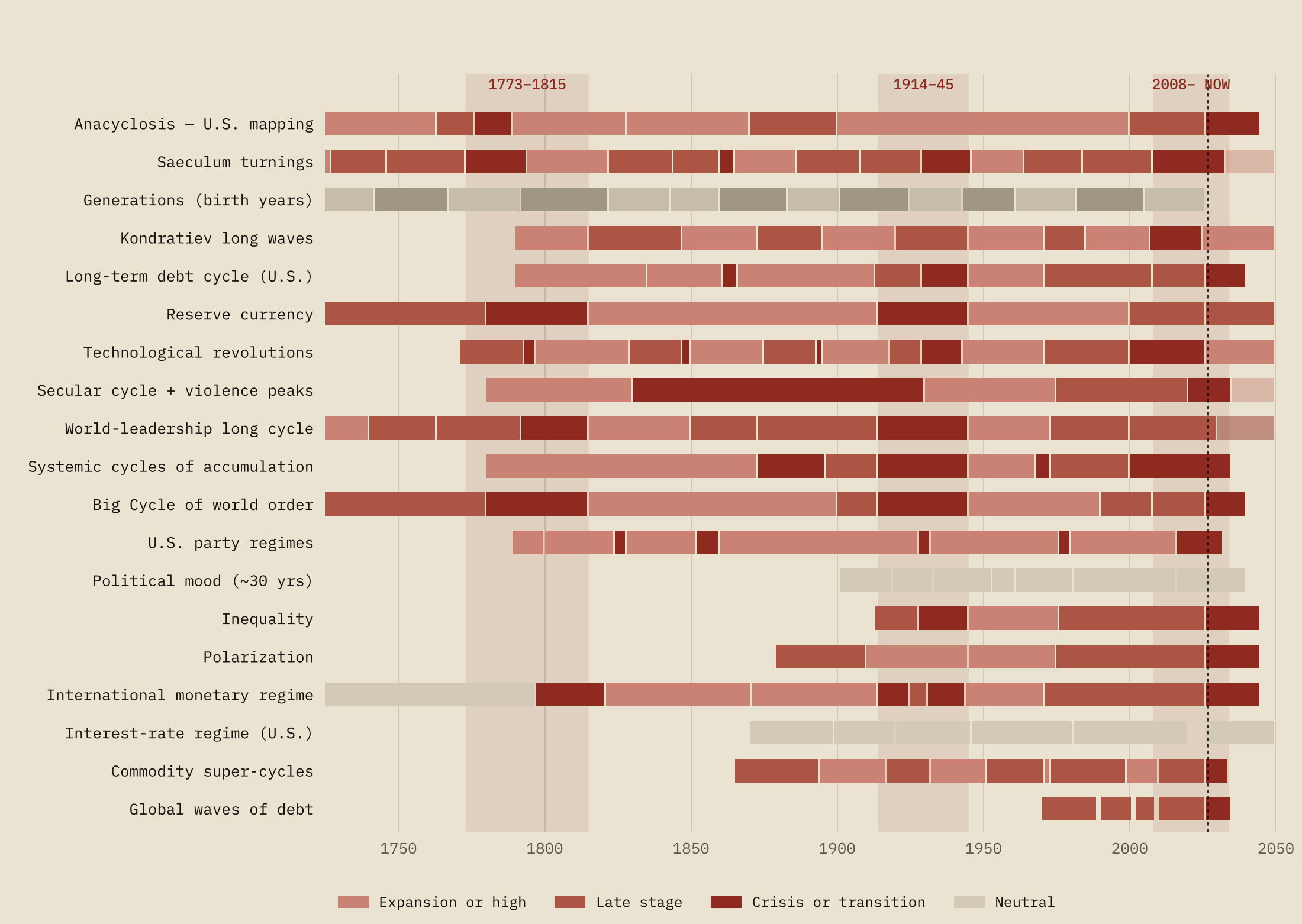
I collected 52 cycle frameworks and plotted every dated turning point from 1725 to 2050 on a single timeline. Of those 52, 23 both put a date on their next turn and have at least some evidence behind them. 21 of the 23 place that turn between 2020 and 2045. The median is 2028, and the densest cluster runs from 2024 to 2032.
That would mean little if the 21 were all variations on one idea. They aren't. They fall into seven families that measure different things:
| Family |
Examples |
Where it stands |
| Generational and elite |
Strauss–Howe saeculum; Turchin's secular cycle |
Crisis era since 2008; instability peak around 2028 |
| Technology and finance |
Kondratiev waves; Perez's revolutions |
End of the ICT wave, start of AI and biotech; turning point around 2030 |
| Debt, money and rates |
Dalio's long-term debt cycle; debt waves; interest-rate regimes |
Late stage; 39-year bond bull ended in 2020 |
| Hegemony and world order |
Modelski; Arrighi; reserve-currency cycles |
U.S. cycle ends around 2030; reserve shift slow, around 2045 |
| U.S. party regimes |
Skowronek's political time; Burnham's realignments |
Late-regime disjunction |
| Social extremes |
Inequality and polarization U-curves; institutional trust |
Records or 100-year highs |
| Land and property |
Harrison's 18-year property cycle |
Next peak around 2026 |
Two frameworks point the other way, and I keep them on the map: Goldstein's hegemony cycle, which puts the next turn near 2095, and the slow pace of reserve-currency succession. Both concern who issues the world's money, and that turns out to matter more than anything else in this series.
Three times in 300 years
If cycles converge all the time, convergence means nothing. So I tested how often it happens.
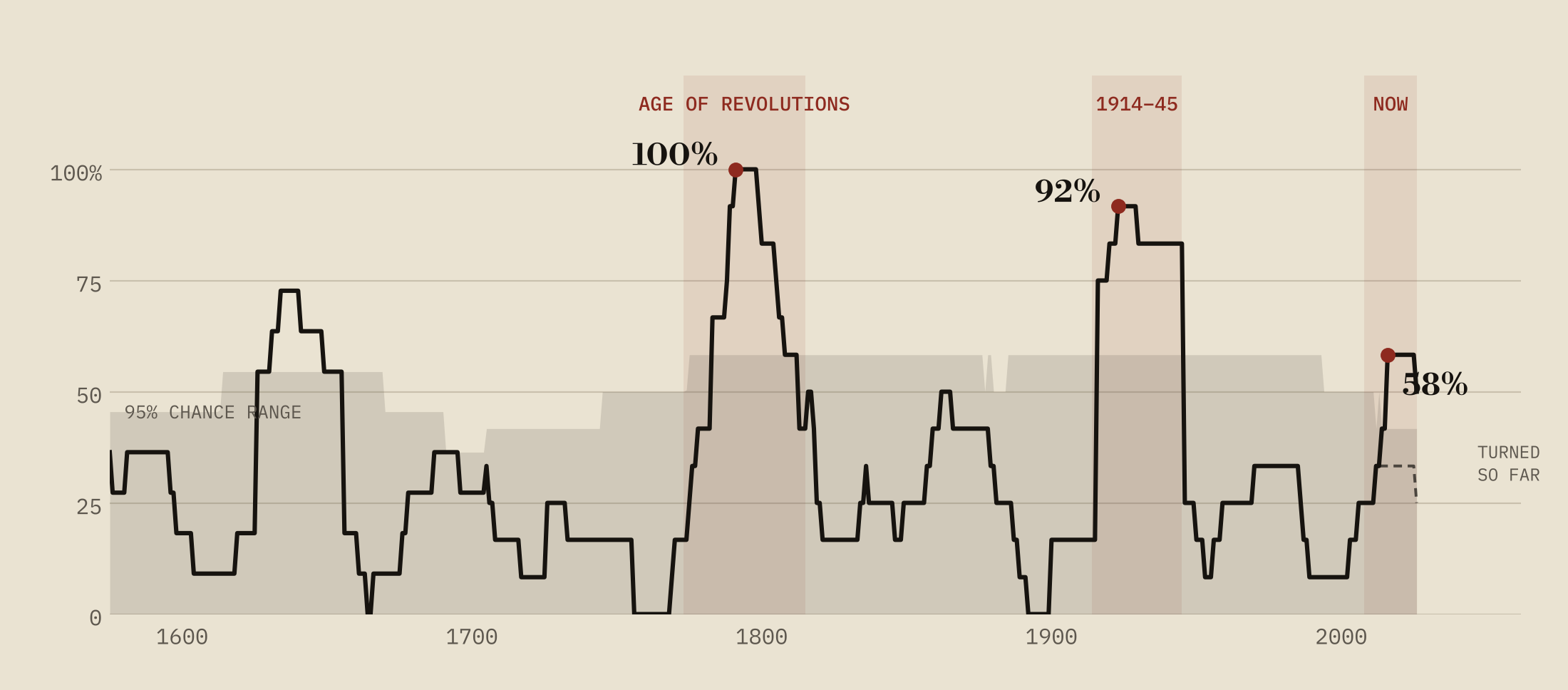
I took the 12 frameworks whose records reach back before 1650, slid a 30-year window across four centuries, and counted how many turned inside each window. Then I ran 3,000 simulations in which every cycle kept its rhythm but had its timing shifted at random. That tells you how much agreement you'd expect by luck alone.
| Era |
Best window |
Cycles turning |
Expected by chance |
| Age of Revolutions |
1776–1805 |
12 of 12 |
about 4 |
| World wars and Depression |
1908–1937 |
11 of 12 |
about 4 |
| Present |
2001–2030 |
7 of 12 (4 turned, 3 due by 2030) |
about 3 |
| General Crisis |
1619–1648 |
8 of 11 |
about 3 |
The first two are not luck. In the simulations, a near-perfect alignment like those of 1776–1805 and 1908–1937 showed up less than once in a thousand runs, anywhere in four centuries. They hold up with 20- or 40-year windows, after I remove every hegemony framework, and when I let every turning point slide anywhere inside its documented dating range.
Think about what those two windows contained. The first gave us the American and French Revolutions, the end of the old European monarchies, Napoleon, and a new world order at Vienna in 1815. The second gave us two world wars, the Russian Revolution, the Great Depression, the end of the gold standard and the order built at Bretton Woods and the United Nations in 1944–45.
The present window counts 7 of 12: four turns already in, and three more that the frameworks date to 2028–2030. That is more than double what chance predicts, but it is not yet in the same league, and part of it is still forecast. That gap turns out to be the most important finding in the analysis, and the next two sections explain why.
The hard data
Skeptics will say theories of cycles are just stories. So I built a measure from hard data alone.
The U.S. Convergence Index combines six measures: federal debt, interest as a share of federal revenue, polarization in Congress, the top 1% share of income, trust in government (inverted), and the number of countries fighting interstate wars. Each is ranked against its own history since 1900, then averaged.
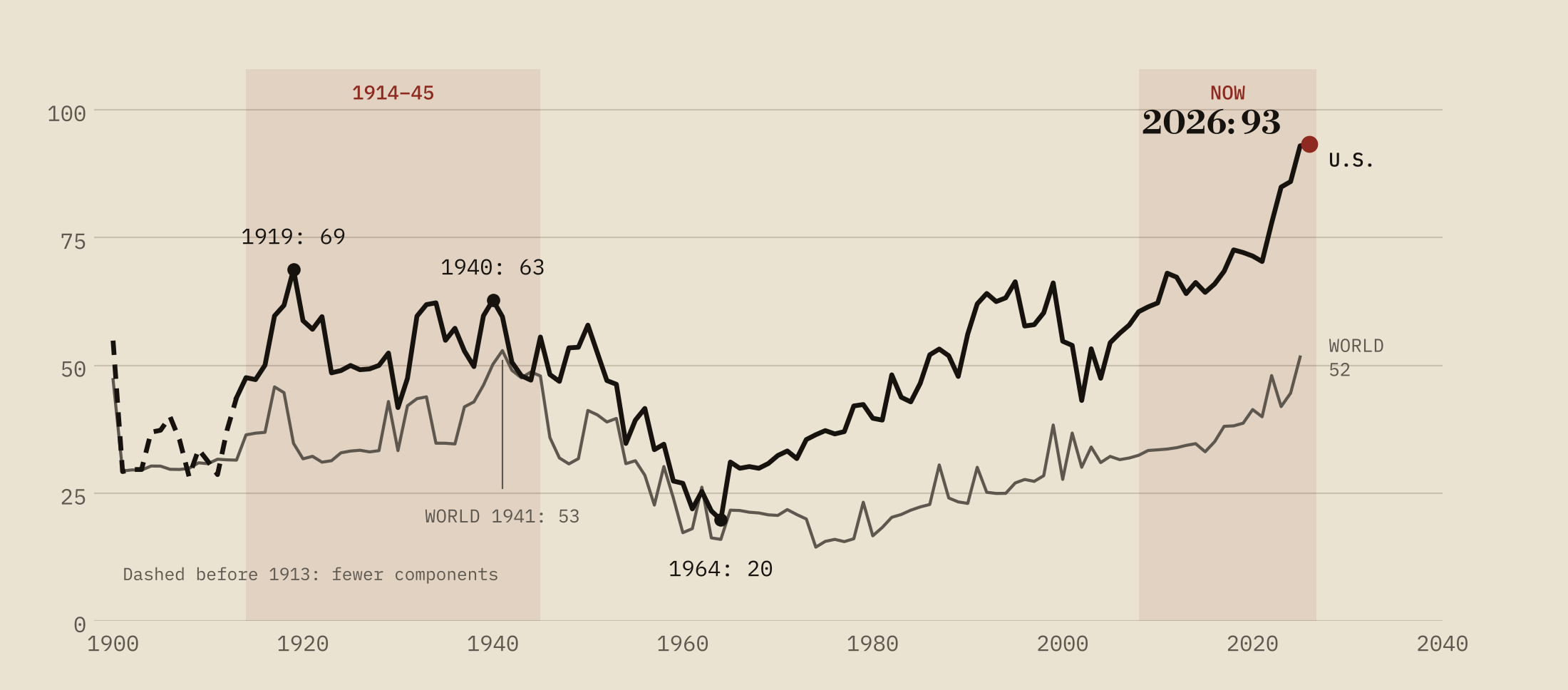
The index peaked at 69 in 1919 and at 63 in 1940, fell to 20 in 1964, and now stands at 93, the highest reading in the series. That holds however the components are scaled and with any one of them dropped. Debt is near 101% of GDP, interest takes 18.6% of revenue, polarization is at a record, and the top 1% share is above 1928.
The pattern differs from 1914–45 in one revealing way. Back then the stress was external: war, war debt, the Depression. Polarization and inequality were falling. Today the internal measures are at records and debt is at wartime levels, while war is only beginning to rise.
The world index, built for the U.S., the five biggest EU economies, China and eight emerging markets, tells the same story. It peaked at 53 in 1941. In 2025 it reached 52. The world's stress index is back where it was in 1941, except that in 1941 the war had already started.
One caveat: the 2025 global reading counts U.S. participation in the June 2025 Iran–Israel war and V-Dem's 2025 downgrade of U.S. democracy, both of which can be debated.
We are in 1791
The present scores only 7 of 12, with some of those still to come, because this convergence is still under way. The window I measured ends in 2030, and several of the slowest clocks haven't struck yet.
To compare fairly, I measured each convergence at the same stage: 18¾ years after it began.
- 1791: 4 of 12 long-run cycles had turned. Eight more came due over the next 20 years.
- 1932: 9 of 12 had turned. That convergence was front-loaded; most of its shocks hit early.
- 2026: 4 of 12 have turned. Four more are due by 2045: Turchin's instability peak around 2028, Modelski's long cycle and the Kondratiev wave around 2030, and the reserve-currency transition around 2045.
On this test the present resembles 1791 far more than the bottom of the Depression. In 1791 the French Revolution was two years old and the Napoleonic Wars hadn't started. The upheaval everyone remembers was still mostly in the future.
That's where we are. The debt, generational and political clocks have struck. The war and world-order clocks are due within the next two decades. A shorter panel of medium-length cycles puts us nearer 1932–33. Both readings say the same thing: the hardest years are probably ahead, most likely clustered between 2028 and 2034.
Those years mark where the clocks say the pressure peaks, if the past is any guide. Nobody can pin it to a single year, and I won't try.
What's different this time
If the story ended there, it would be a story about history repeating. But this convergence is colliding with forces that neither earlier one had:
- Artificial intelligence, compressing decades of economic change into years.
- Strong cryptography and global networks, which let money, information and organization move beyond any single state's reach.
- Cheap autonomous weapons. Ukraine built roughly 2.2 million drones in 2024; drones now cause most battlefield casualties on its front.
- Tightly coupled systems. In 2023 Silicon Valley Bank lost about $42 billion in deposits in a single day. In 2024 one faulty software update knocked about 8.5 million computers offline.
- Nuclear deterrence and aging populations, the two big brakes that 1914 didn't have.
When I scored how ten of these forces interact with the cycles, 28 interactions add fuel and only 5 act as brakes. Four of those five brakes come from nuclear weapons and aging, and they work mainly on one thing: great-power total war.
That leads to my core hypothesis about the decade ahead. The pressure is as great as in 1914–45, but all-out war between great powers, the old release valve, is partly blocked. So the energy goes somewhere else: into markets, money, cyberspace, information wars, internal unrest, and real wars at the edges.
There is one more difference, and it may be the biggest of all: almost every clock is turning except the ones that govern money. Essay 8 is about that gap.
Where this could be wrong
I'd rather name the weak points myself than wait for critics to find them.
- Circularity. Some world-order theories date their turning points by the great wars themselves, so of course they line up with the great wars. I tested this directly. The clocks dated with no reference to war at all — prices, defaults, money and revolutions — turned together in 1776–1805 too. And on seven economic and political series that no cycle theorist chose, with war left out entirely, all three eras still run well above normal; the odds of that by chance are less than one in a thousand. But a second test failed: you can't forecast a convergence from each cycle's average length. The cycles cluster; they don't keep a schedule.
- Hindsight. Many authors wrote about "now" knowing it was turbulent. The answer is the forecasts written down in advance: Modelski in 1987 put the end of the U.S. cycle around 2030; Turchin in 2010 predicted an American instability spike around 2020; Samuel Huntington in 1981 put America's next great "creedal passion" period in the 2020s and 2030s. Of the dated cycle forecasts that have come due, six hit, three partly hit, and none missed.
- America-centrism. Much of the data is American. The global index answers part of this, not all.
- Thin early data. Interest figures before 1940 are estimates, and coverage before 1913 is partial.
And here is what would change my mind. If the next eight years bring falling debt burdens, easing polarization, rising trust, fewer wars, and a quiet hand-off in world order, the theory fails. I've published the indicators and the thresholds, fixed in advance, so anyone can hold me to that.
What this theory does not claim: that collapse comes on a set date, that cycles are laws of physics, or that any one technology fixes everything. Cycles are lenses. The evidence is in the tests.
The question
Three times in 300 years the clocks of history have struck together. 1776. 1914. Now.
The first time, the world emerged with new nations, new rights and a new balance of power. The second time, it emerged with a new monetary system, new global institutions and a nuclear peace, after paying for them with tens of millions of lives.
If I'm right, we are near the start of the third. The order we grew up in will be remade, and the hardest stretch is probably 2028 to 2034. Those years will likely be hard for a lot of people. They don't have to be hard for you.
Some people make things happen. Some watch things happen. Some wonder what happened. This series is about staying out of that last group: knowing where the clocks stand, what turned last time and who paid for it, and what is different now, including tools no previous generation had.
Over the coming weeks I'll take each clock in turn: the full long-run test, the stress index that has peaked only twice before, why Europe and China are on different hours, what a Greek historian worked out about decaying democracies more than 2,000 years ago, where the money clocks stand, and the strongest case against all of it.
Next, on Monday: Three Times in 300 Years, the full long-run test and what each convergence looked like from the inside.