Three Times in 300 Years
Essay 2 of the Supercycle series · Walker America · Draft, October 2026
The test that could have sunk the theory
Every theory of history has a weak spot, and for cycle theories it's this: if you look hard enough, you can find a cycle turning in any decade you like. Pick a turbulent era, find a framework that dates a turning point near it, and declare a pattern. Do that, and what you have is a horoscope with footnotes.
So before I wrote a word of this series, I tried to break the idea. If the great cycles converge all the time, then the convergence we're living through means nothing. If they converge only rarely, and the rare moments line up with the eras that remade the world, then we have something worth taking seriously.
This essay is about that test. In brief, the clocks of history have struck together three times in the last 300 years, and twice the alignment was too tight to be luck.
How the test works
The first problem is fairness. Most cycle frameworks were built from 19th- and 20th-century data, so they have more turning points in recent centuries simply because there's more record to work with. Compare 1790 to 1930 using those, and you're comparing a thin record to a thick one.
So I used only the frameworks whose chronologies reach back before 1650. Twelve qualify. They come from five different families of thought:
| Family |
Frameworks |
| Generations |
Strauss–Howe crisis eras |
| Structural-demographic |
State-breakdown waves (Goldstone, extended by Turchin) |
| World order |
Modelski's global wars; Toynbee's war-and-peace cycle; Goldstein's hegemonic wars; Arrighi's cycles of accumulation; reserve-currency transitions; Dalio's world-order cycle |
| Long economic waves |
Modelski and Thompson's leading-sector waves; Fischer's price revolutions |
| Money and debt |
Reinhart and Rogoff's default waves; breaks in the core monetary regime |
Then I slid a 30-year window across four centuries, one year at a time, and counted how many of the twelve had a turning point inside each window.
That gives a count for every 30-year stretch from the 1560s to today. But a count alone doesn't tell you much. Twelve cycles with periods of 50 to 150 years will sometimes bunch up by accident. The question is how often.
So I ran the history 3,000 more times with the alignment scrambled. In each run, every framework kept its own rhythm (its own intervals between turns), but its whole chronology was shifted forward or back by a random amount. That is the fair comparison: the same clocks, ticking at the same speeds, just not synchronized. Whatever level of agreement shows up in those scrambled runs is what you'd expect from chance.
What it found
| Era |
Best 30-year window |
Cycles turning |
Expected by chance |
Odds of chance, anywhere in four centuries |
| General Crisis |
1619–1648 |
8 of 11 |
about 3 |
62% |
| Age of Revolutions |
1776–1805 |
12 of 12 |
about 4 |
under 0.1% |
| World wars and Depression |
1908–1937 |
11 of 12 |
about 4 |
under 0.1% |
| Present |
2001–2030 |
7 of 12 (3 still due) |
about 3 |
99% |
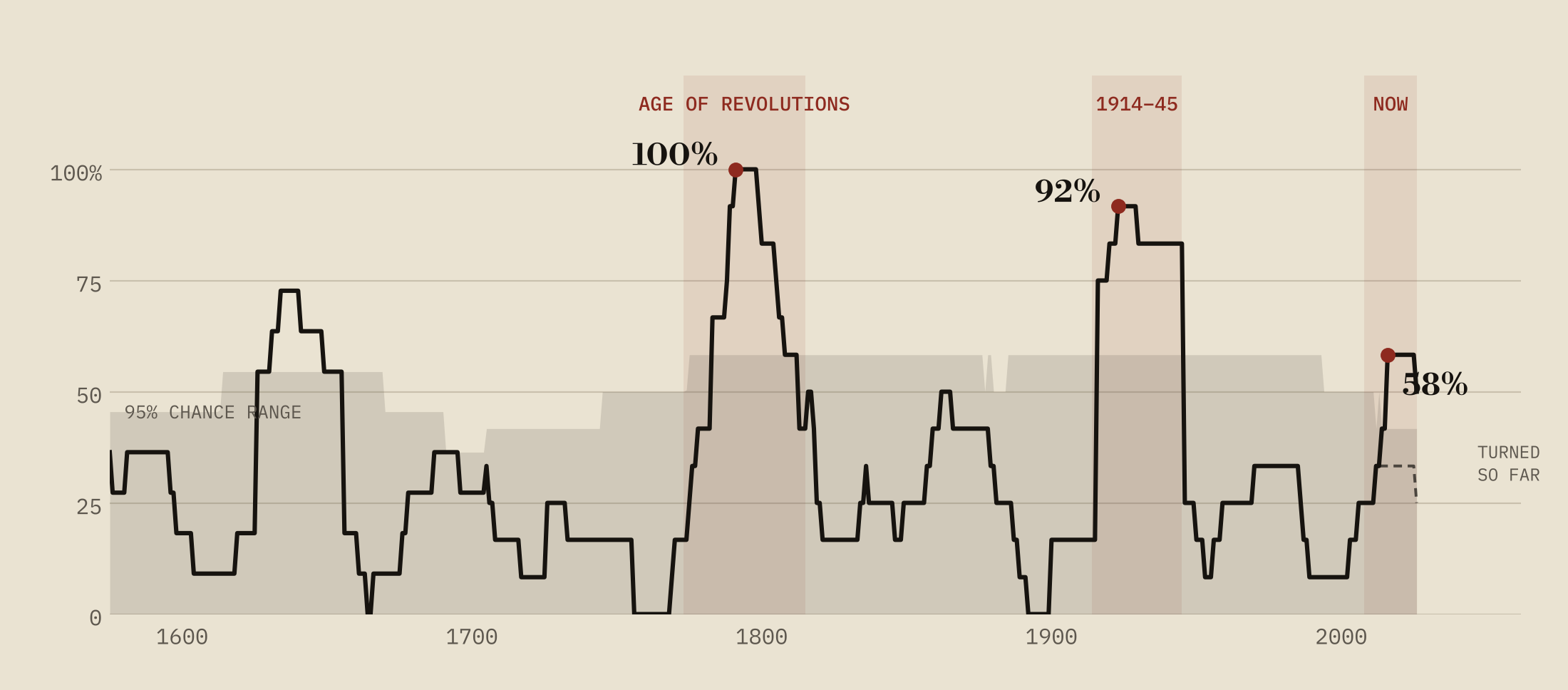
Two eras stand alone. Between 1776 and 1805, every one of the twelve frameworks turned. Between 1908 and 1937, eleven of twelve did; the only holdout was Fischer's price revolution, whose current wave has no dated climax. In the scrambled runs, an alignment that tight showed up less than once in a thousand, anywhere in four centuries.
I checked the obvious ways this could be an artifact. Shrink the window to 20 years or widen it to 40: both eras still stand out. Remove the entire world-order family, the frameworks most open to the charge that they were dated by the wars themselves: both eras still stand out.
I also checked the dates themselves. Historians disagree about exactly when a crisis began or peaked, so I let every turning point slide anywhere inside its documented range and re-ran the test 3,000 times. Both eras stayed above chance in more than 99 runs of every 100.
The sharper objection is that many of these frameworks date their turns by the same wars, so their agreement is one event counted several times. War does sit inside many of them, because war is where the pressures of an era break through. What matters is whether the agreement goes deeper than the wars, and two checks say it does. First, the four clocks dated with no reference to war at all — prices, defaults, monetary acts and revolutions — turned together too: all four between 1776 and 1805, three of four between 1908 and 1937. Second, the frameworks don't simply count big wars. The Seven Years' War killed about a million soldiers, and none of the twelve clocks turned. The French Revolutionary Wars killed fewer, and all twelve did. The clocks single out the wars that remade the order.
Most windows score between 20% and 55%, so the method doesn't find drama everywhere. It found it twice.
The Age of Revolutions, from the inside
On the ground, "twelve of twelve" looked like this.
In the 1770s the British Empire was at the height of its first age of power and deep in debt from the Seven Years' War. It tried to make the colonies pay. They refused, and in 1776 thirteen of them declared independence. France bankrolled the American war and drove its own finances to the edge. By 1788 the French crown couldn't borrow, and called the Estates-General for the first time since 1614. In 1789 the Bastille fell.
What followed was a quarter-century of upheaval that touched every one of the twelve clocks:
- Generations and elites. A rising generation pushed aside an old order that had lost its legitimacy. Too many aspiring elites competed for too few positions, and state finances collapsed.
- Money. The Bank of England suspended gold payments in 1797 to finance the war. A wave of sovereign defaults ran from France in 1770 and 1788 through Spain, the Netherlands, Austria and Portugal.
- World order. Revolutionary and Napoleonic France fought the rest of Europe from 1792 to 1815. The Dutch financial world gave way to the British. Sterling began its rise to the world's anchor currency.
- The economy. A new leading sector, British cotton and iron, began a long wave of growth, while prices that had risen for decades peaked and broke.
It ended at Vienna in 1815, where five great powers redrew the map of Europe and built a system to manage their rivalry. Europe then went nearly a century without a general war.
1914–1945, from the inside
The second convergence was compressed into half the time and was far more violent.
It began with a war almost nobody expected to last, and that killed the old monarchies of Russia, Germany, Austria-Hungary and the Ottoman Empire. It went on through a revolution in Russia, a decade of fragile recovery and a financial crash in 1929. It went through the collapse of the gold standard: Britain left in 1931, and the United States followed in 1933 after ordering its citizens to hand in their gold. Then came a second world war.
Again, every family of clocks turned. A generational crisis ran from the Depression through the war. Hegemony passed from Britain to the United States. Sterling gave way to the dollar. A wave of sovereign defaults swept through the 1930s. The leading sectors changed from steel and railways to cars, electricity and chemicals.
It ended at Bretton Woods in 1944 and San Francisco in 1945, where the winners built a new monetary system and a new set of global institutions. That order has lasted, with repairs, for 80 years.
The one that didn't quite make it
The General Crisis of the 1600s deserves a mention because it shows the test isn't rigged in favor of drama.
The mid-17th century was a catastrophe. The Thirty Years' War devastated Central Europe. England had a civil war and executed its king. The Ming dynasty fell. Spain went bankrupt. Eight of eleven frameworks turned between 1619 and 1648, more than double what chance would give.
But against four centuries of scrambled history, that level of agreement isn't rare enough to rule out luck (62%). The General Crisis was real and terrible, but it was a partial convergence. Some clocks were elsewhere, including the generational clock and the two great-war clocks of Modelski and Toynbee. The test can tell a bad era from a great convergence.
The 1850s are the mirror image. China's Taiping war killed tens of millions. Britain, France and Russia fought in Crimea, India rose against the East India Company, Japan's shogunate began to unravel, and America went to civil war. By violence alone, few decades compare. Yet only about four of the twelve clocks were in step, and the order held: no new hegemon, no new money, no new settlement. Violence on that scale, with the clocks out of step, left the order standing.
Measuring how tightly the clocks align
Counting turning points in a window treats a turn in year 1 and a turn in year 30 as equal. The physics of waves offers a sharper measure.
Think of each cycle as a wave. At a turning point it's at its crest. Halfway between turning points it's at its trough. Waves that crest together reinforce each other: two waves in step make a crest twice as tall. Waves out of step cancel. With many waves, the difference is dramatic. Twelve waves in step hit with up to twelve times the force of twelve scattered ones.
So I gave each of the twelve frameworks a phase for every year, from 0° at a turning point around to 360° at the next, and measured how many were effectively in step.
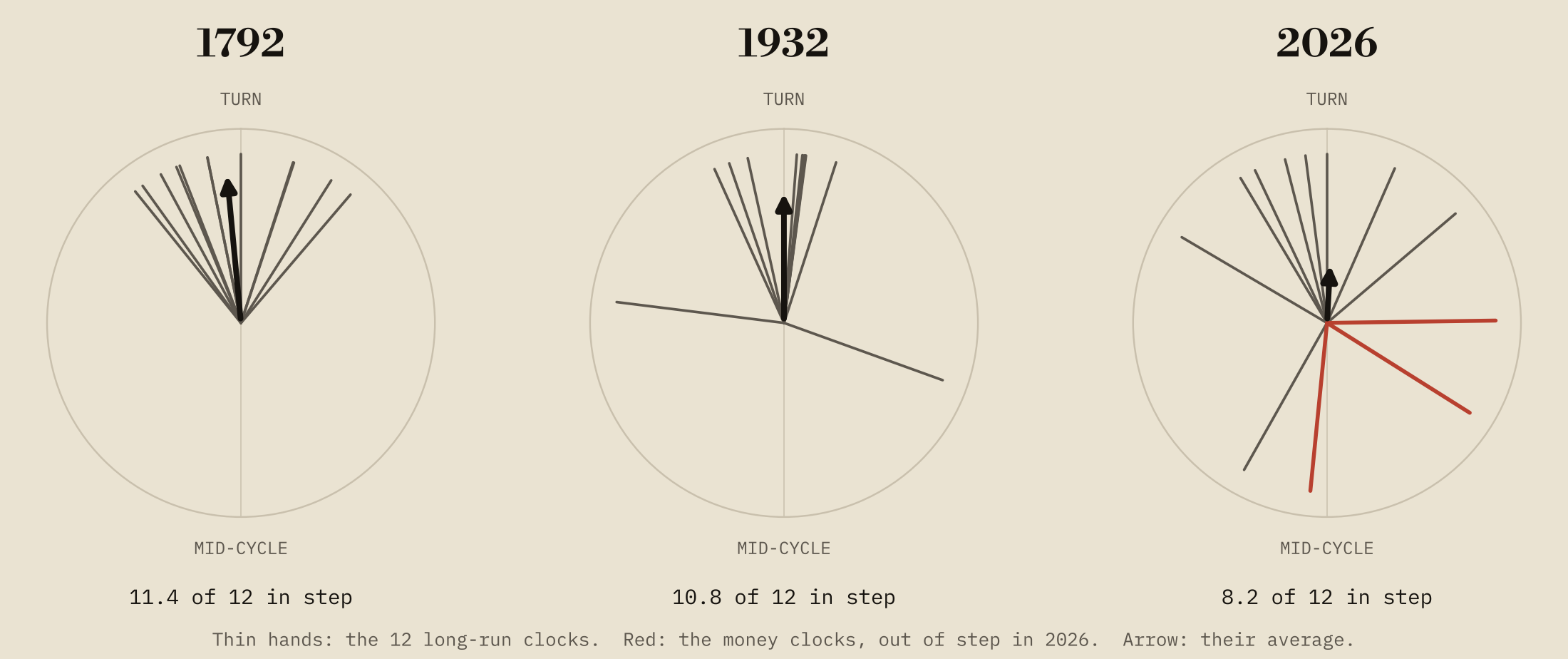
In 1792, about 11.4 of the 12 were in step. In 1932, about 10.8. Both are far beyond anything the scrambled runs produce. Today the figure is about 8.2, above chance for this year (in 10,000 scrambled runs, about 3 in 100 reach it), but not in their league.
The alignment also tracks something real. Across every decade since 1790, the more clocks in step, the higher the stress on hard data no cycle theorist chose (a correlation of 0.68). Leave out both great convergences and the link still holds (0.47).
Look at which hands point the wrong way today: the clock of monetary regimes (the last break was 1971), the price-revolution clock, the default-wave clock (the last cluster was 2008–12), and the very long hegemonic-war cycle. Three of the four are about money, and Essay 8 argues that this may be the most important thing in the series.
So where does the present stand?
This is where it would be easiest to oversell.
On the long-run test, the present doesn't yet match the other two. Its best window, 2001–2030, counts seven of twelve, and three of those seven are turns the frameworks date to 2028–2030 that haven't happened. On completed turns alone, today is not yet exceptional by the standard of four centuries.
I still think we're in the third great convergence rather than a bad patch, for three reasons, each covered in its own essay:
- The clocks that haven't turned are due soon. Measured at the same stage, today looks like 1791: the French Revolution two years old, the Napoleonic Wars still ahead. In 1791, only four of the twelve had turned too.
- The hard data agree. America's stress index, built only from measured data, is at its highest since 1900. On series no cycle theorist chose, all three convergence eras run hot together, with odds of chance under one in a thousand. Measured against each series' own previous half-century, today runs hotter than either earlier era.
- The broader set of cycles agrees. Of 23 dated frameworks in the full dataset, including ones founded before 1990, 21 place their next turn between 2020 and 2045. Seven frameworks added since, three of them hard series that turned in 2018–25, raise that to 26 of 28.
The long-run test does one job: it shows that great convergences are real and rare, and that the last two remade the world. It doesn't yet prove that we're in the third. The rest of the evidence makes that case, and the next few years will settle it.
What the test settles
Great convergences are real. Twice in 300 years, essentially every major long cycle turned within the same 30 years, and both times the world order was torn down and rebuilt.
They are also rare. Most decades, the clocks disagree. That's why most lives are lived in ordinary times, and why it is so hard to believe you're living in an extraordinary one.
And the present is on track to be the third, though it isn't there yet. The clocks still to strike are the war clocks and, above all, the money clocks. When the money clocks turned in 1797 and 1931–33, the world's monetary order changed hands. Which hands it passes to this time is the question at the center of this series.
Next: The Line That Peaked Twice, America's Convergence Index, built from hard data alone.