We Are in 1791
Essay 5 of the Supercycle series · Walker America · Draft, October 2026
A year that didn't feel like the middle of anything
Imagine it's the end of 1791.
The French Revolution is two years old. The king has tried to flee Paris in disguise, been caught at Varennes and brought back. France has a new constitution, a constitutional monarchy, and many people think the revolution is essentially over. Across the Atlantic, the United States has just ratified the Bill of Rights, and Alexander Hamilton has chartered the first Bank of the United States. In Saint-Domingue, the richest colony in the world, enslaved people have risen in revolt.
If you lived through 1791 you knew things were turbulent. You did not know that the Terror, a quarter-century of European war, Napoleon, the end of the Holy Roman Empire, the British suspension of gold payments, and a new world order were all still ahead. Most of the upheaval we now call the Age of Revolutions hadn't happened yet.
That is where I think we are.
Measuring at the same stage
Comparing the present to past convergences has a built-in trap. We know how 1776–1815 and 1914–45 ended. We don't know how this one ends. So comparing today with the whole of an earlier convergence makes today look smaller than it is, because we're comparing a story with its ending to one without.
The fair comparison is stage against stage. I dated each convergence from its start (1773, 1914 and 2008) and measured how many of the twelve long-run cycles had turned by the same point: 18¾ years in.
| Stage |
Cycles turned (of 12) |
Due in the next 20 years |
| 1791 (Age of Revolutions) |
4 |
8 |
| 1932 (1914–45) |
9 |
2 |
| 2026 (present) |
4 |
4 (the last, reserve currency, ~2045) |
1914–45 was front-loaded. By 1932 most of its shocks had already landed: the war, the revolutions, the crash, the gold standard's collapse. If today looked like 1932, the worst would be behind us.
Today looks more like 1791.
The same clocks, in the same order
What makes the comparison more than a coincidence of numbers is which clocks had turned.
|
Turned by 1791 |
Turned by 2026 |
| Generational crisis (Strauss–Howe) |
Yes |
Yes |
| Cycles of accumulation (Arrighi) |
Yes |
Yes |
| Sovereign default wave (Reinhart & Rogoff) |
Yes |
Yes |
| State breakdown (Goldstone, Turchin) |
Yes |
Due ~2028 |
| World-order Stage 6 (Dalio) |
No |
Yes |
| Global war (Modelski) |
No, came in 1792–1815 |
Due ~2030 |
| Long wave (Modelski & Thompson) |
No, came in the 1790s |
Due ~2030 |
| Reserve-currency transition |
No, came 1780–1815 |
Due ~2045 (slow) |
| War and peace (Toynbee); hegemonic war (Goldstein) |
No, came 1792–1815 |
Not dated in the window |
| Monetary regime; price revolution |
No, came 1797 and ~1805 |
Not dated in the window |
Three of the four clocks that had turned by 1791 are the same three that have turned now: the generational crisis, the terminal crisis of the leading financial power, and a wave of sovereign defaults. In 1791 those were followed, within a decade, by the war clocks, the world-order clocks and the money clocks.
The sequence in both cases runs from the inside out. First the domestic and fiscal clocks turn: a generation loses faith in its institutions, the financial system that funded the old order cracks, and governments can't pay their debts. Then the international clocks follow: war, the transfer of hegemony, a new monetary order.
What came next, last time
Here is how the twenty years after 1791 unfolded.
| Year |
Event |
| 1792 |
France declares war on Austria; the monarchy falls |
| 1793 |
The king is executed; the Terror begins; Britain joins the war |
| 1797 |
The Bank of England suspends gold payments to fund the war |
| 1799 |
Napoleon takes power |
| 1803–06 |
War resumes; the Holy Roman Empire is dissolved after a thousand years |
| 1806–07 |
Napoleon's Continental System tries to strangle British trade |
| 1812 |
The invasion of Russia; the U.S. and Britain go to war |
| 1815 |
Waterloo; the Congress of Vienna writes a new order |
Most of what we remember about the Age of Revolutions happened after 1791. The revolution was only the front edge.
What the analogy does not say
An analogy like this is easy to abuse, so its limits matter.
It does not say a Napoleon is coming, that Europe will go to war, or that 2026's events map onto 1791's.
It also gives no date. The second blind test I ran showed that a convergence can't be forecast from each cycle's average length, because the intervals vary too much.
What the analogy does say is narrower. On the long-run test, the clocks that have turned are the ones that turned first last time, and the clocks still to turn are the ones that turned second. In the earlier convergence the second wave was the larger one.
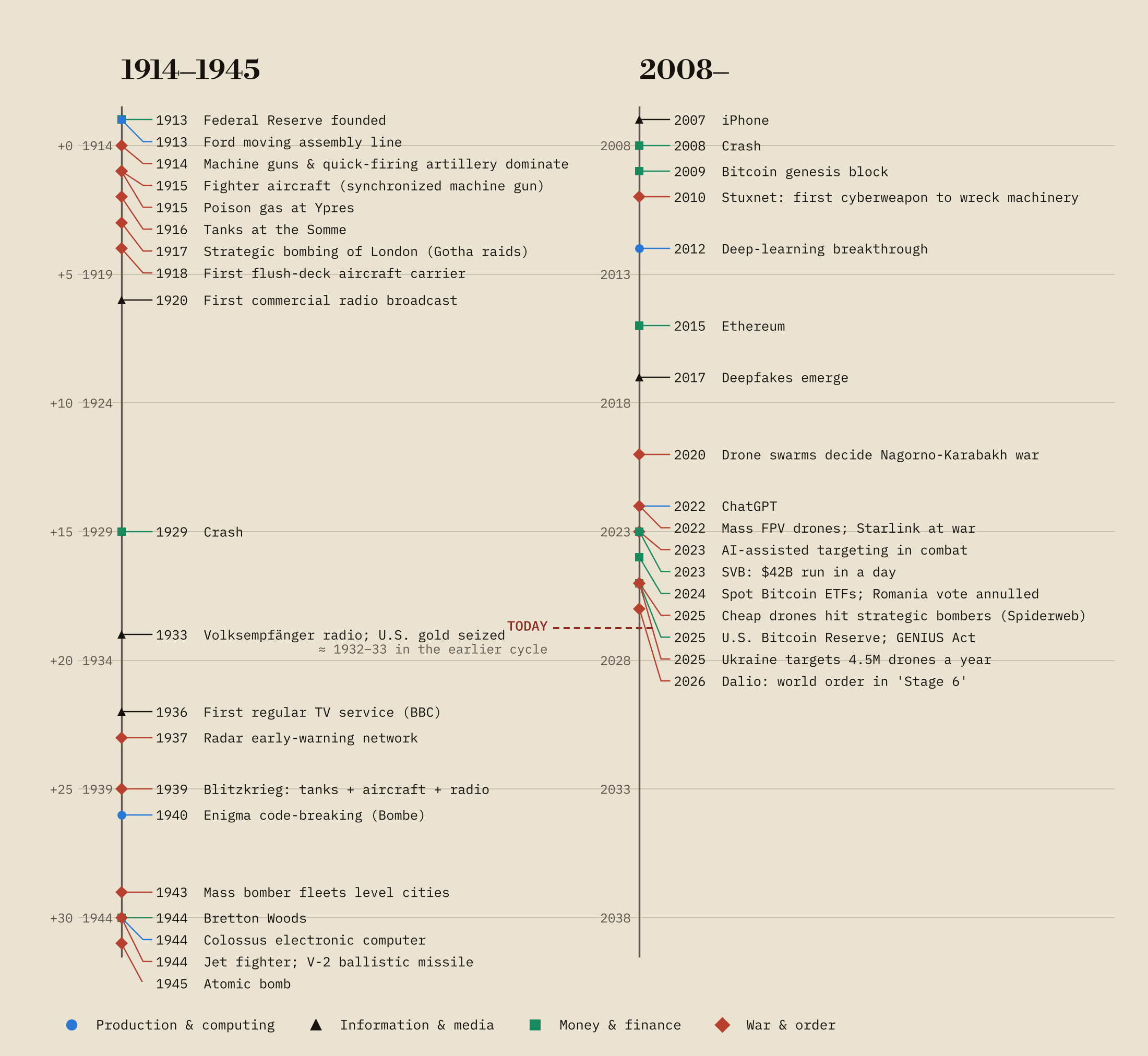
A second reading: 1932–33
A second way of lining things up gives a different year and the same message.
Take a shorter panel of medium-length cycles (the twenty frameworks with at least two dated turns since 1750) and align the convergences by their start, 1914 against 2008. On that reading, today sits near 1932–33. In America that was the bottom of the Depression, with Roosevelt arriving and the banking system shut down. It was also before Hitler's rearmament, before the war, before Bretton Woods.
Both readings, 1791 on the long panel and 1932–33 on the short one, say the same thing: the hardest years are probably ahead, most likely clustered between 2028 and 2034. Those are the years where the frameworks' own dated turns bunch up: Turchin's instability peak around 2028, Modelski's long cycle and the Kondratiev wave around 2030, Howe's crisis climax around 2030 and resolution around 2033.
The clocks still to strike
Two groups of clocks remain.
The war clocks. Modelski's global-war cycle, Toynbee's war-and-peace cycle, the hegemonic transition. On the hard data, war is the one measure that hasn't yet spiked: six countries in interstate wars in 2025, the most since 2001, against seventeen in 1940. Nuclear weapons may keep it that way between great powers. That's the subject of Essay 10. But the pressure has to go somewhere.
The money clocks. The monetary regime has not broken since 1971. The default wave of 2008–12 has passed. When I measure how well the clocks are aligned, using a wave-interference method, these are precisely the clocks that are out of step. If they turn, the alignment roughly triples, and today joins 1792 and 1932 as a full convergence.
In 1797, the money clock turned when Britain suspended gold payments to fund the war. In 1931–33 it turned when the gold standard collapsed. Both times the world's monetary anchor changed hands: to sterling after 1815, to the dollar after 1944.
What to watch
If the analogy holds, the next few years should bring the international clocks into play. These are the signposts, each tracked on the falsification tracker:
- War: the count of states fighting interstate wars; any direct great-power clash.
- Money: a formal change in the monetary regime, such as yield-curve control, capital controls, or a change to what backs the dollar; sovereign debt stress in a G7 state.
- World order: the dollar's share of reserves; a new treaty-based institution.
- Domestic: a constitutional crisis; election legitimacy.
And if none of that happens — if by the end of 2032 the indices have eased and no regime breaks have occurred — the analogy failed, and I'll say so.
The front edge
People living through the front edge of a great convergence rarely know it. In 1791 it was possible to believe the revolution was finished. In 1932 it was possible to believe the worst of the Depression was the worst there would be.
In 1627 the Chinese writer Feng Menglong recorded a saying: "Better to be a dog in times of peace than a human in times of chaos." The Ming dynasty had seventeen years left. Three centuries later, in 1936, British officials began quoting a gentler version and calling it an ancient Chinese curse: "May you live in interesting times." The curse was invented, but the timing was apt. Both sayings come from inside a convergence, written by people who could feel the ground moving.
I think we're at the front edge. The domestic, generational and financial clocks have struck. The war and money clocks haven't. Last time, the second set was the one that remade the world.
Next: The Cycle of Power, on Polybius, political time, polarization and trust, and the oldest cycle theory of all.