The Cycle of Power
Essay 6 of the Supercycle series · Walker America · Draft, October 2026
The oldest cycle theory
Around 150 BCE a Greek hostage in Rome named Polybius tried to explain how a single city had conquered the Mediterranean world in barely fifty years. His answer, in Book VI of his Histories, became the oldest cycle theory in the Western tradition.
Governments, he argued, move through a natural sequence. Rule by one begins as kingship and decays into tyranny. The best citizens overthrow the tyrant and rule as an aristocracy, which decays into oligarchy. The people overthrow the oligarchs and rule as a democracy, which decays into what he called ochlocracy: mob rule, demagogues, and the use of the public purse to buy the crowd. Out of that chaos a strongman emerges, and the cycle begins again. He called it anacyclosis.
Rome escaped the cycle for a time, Polybius thought, because its constitution mixed all three forms: consuls for the one, the Senate for the few, the assemblies for the many. Each checked the others.
The American founders read Polybius. John Adams quoted him at length. The separation of powers is, among other things, an attempt to build a mixed constitution that can resist anacyclosis.
A lens without a clock
Before going further, let me grade this. Anacyclosis is class P in this series: a philosophical lens with no clock. Polybius gives no periods and no dates. Real regimes are always mixtures. Applying his sequence to modern America is an act of interpretation.
So I treat it the way I treat any philosophical cycle. It's a lens for organizing what the data show, and it never counts as evidence.
The wheel itself, with Rome, Athens, revolutionary France and the United States run through it, is on its own page.
With that said, here is my hypothesis: America shows the features Polybius associated with late democracy: rising factionalism, collapsing trust in institutions, the use of public money to win elections, and growing appetite for a strongman who promises to cut through it all. Polybius would recognize the stage. Recognizing it is a long way from predicting that the republic falls.
What makes this worth more than a classical allusion is that three modern measurements, built by people who weren't thinking about Polybius at all, point the same way.
Measurement 1: polarization
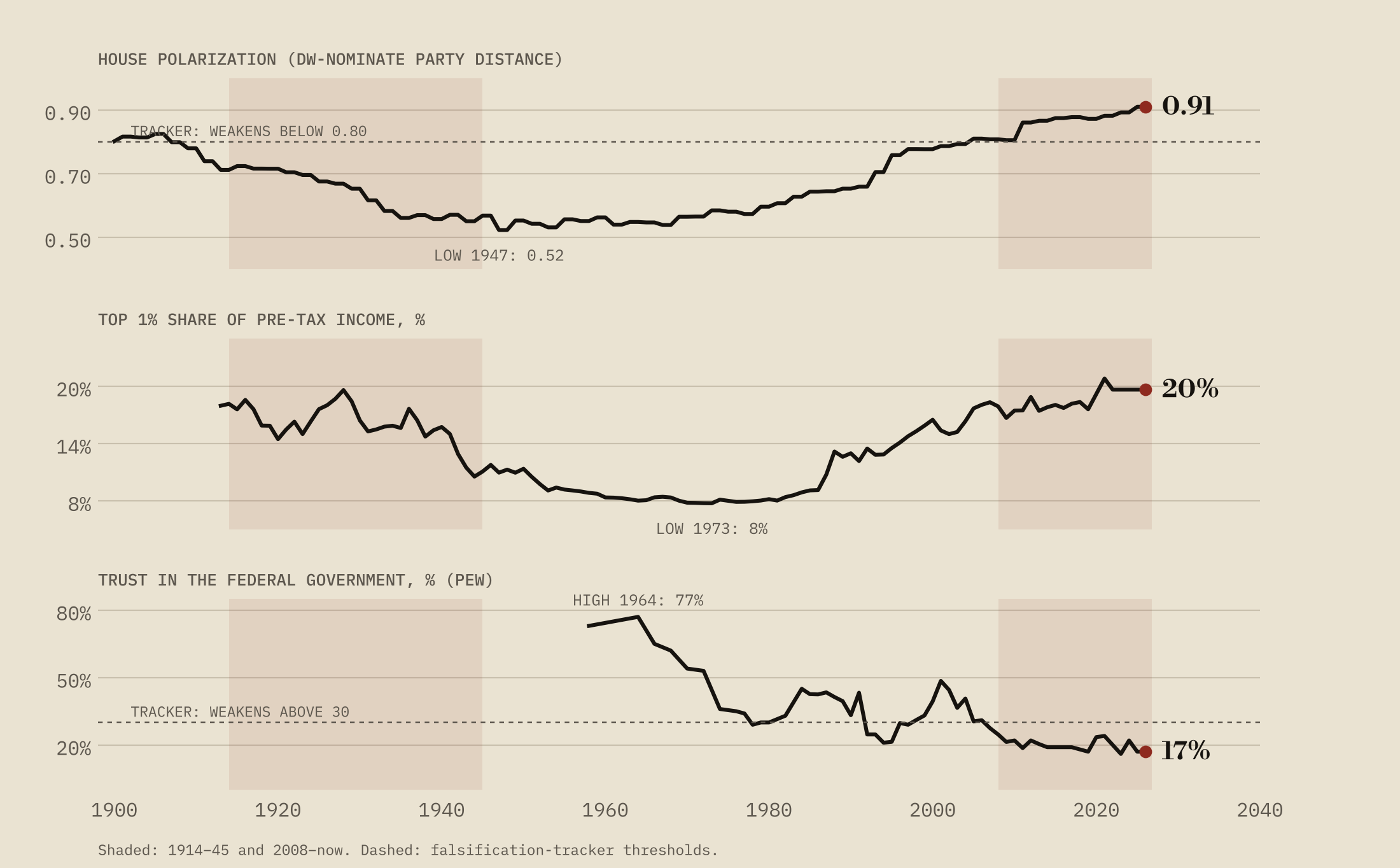
Political scientists measure polarization by placing every member of Congress on an ideological scale using their roll-call votes, the DW-NOMINATE method maintained by Voteview, and then measuring the gap between the two parties.
The result is one of the cleanest cycles in American data:
- High polarization around 1900, peaking in the 1890s (0.84 on the House measure).
- A long decline to a low in the 1940s through the 1970s, when liberal Republicans and conservative Democrats overlapped heavily.
- A steady climb from the late 1970s to today.
- 0.91 in 2025–26: the highest in the record, which goes back to 1789, above even the years before the Civil War.
The shape is a U, and inequality traces almost the same U a few years later. That pairing, polarization and inequality rising and falling together, is one of the most robust findings in American political economy.
Measurement 2: trust
In 1958, when the American National Election Studies first asked, about three-quarters of Americans said they trusted the federal government to do what is right "just about always" or "most of the time." In 1964 it was 77%.
Pew Research Center's latest reading, for 2025, is 17%.
There have been rebounds: in the mid-1980s, briefly after 9/11. But the direction over sixty years is unmistakable. A government that one in six citizens trusts is governing on a much thinner base than one that three in four trust. In Polybius's terms, it has lost the popular consent that held the mixed constitution together.
Measurement 3: political time
Stephen Skowronek, a Yale political scientist, offered a more specific cycle in The Politics Presidents Make (1993). American politics, he argued, runs through regimes, each founded by a "reconstructive" president who repudiates the old order:
| Regime founder |
Regime |
Its last, "disjunctive" president |
| Jefferson |
Jeffersonian |
John Quincy Adams |
| Jackson |
Jacksonian |
Pierce and Buchanan |
| Lincoln |
Republican |
Hoover |
| Franklin Roosevelt |
New Deal |
Carter |
| Reagan |
Reagan era |
Debated |
Disjunctive presidents inherit a regime whose ideas no longer fit the country's problems. They are usually judged failures, less for lack of skill than because the coalition they lead has run out of answers. Each disjunction was followed by a reconstruction: a new coalition, a new set of ideas, and a new relationship between the government and the governed.
Where is America now? Skowronek and others have argued that the Reagan regime has been in its late phase for some time, and the question of whether recent presidencies are disjunctive or reconstructive is debated. What isn't debated is that the old coalitions no longer hold. Both parties have been reshaped from within since 2016.
Skowronek's regimes have lasted roughly 30 to 70 years. The Reagan regime began in 1980. By his model it is old.
Measurement 4: elites
Peter Turchin, the most quantitative of modern cycle theorists, adds a mechanism. His structural-demographic theory says instability builds when three things happen together:
- Wages stagnate for ordinary workers.
- The number of people competing for elite positions grows faster than the positions themselves. He calls this elite overproduction: more lawyers, more graduates, more aspiring politicians than there are seats.
- The state's finances weaken.
Frustrated would-be elites become counter-elites. They organize the discontented and attack the institutions that shut them out. In 2010, Turchin forecast an American instability spike around 2020. His model puts the current wave's peak around 2028.
Turchin's work is class A here: it is built on centuries of data and formal models, and it made a dated forecast in advance.
What the lenses agree on
| Lens |
Class |
What it says now |
| Anacyclosis (Polybius) |
P |
Late democracy, with features of decay |
| Polarization U-curve (Voteview) |
A |
Record high |
| Trust (ANES/Pew) |
A |
Near the lowest ever measured |
| Political time (Skowronek) |
B |
A late regime; coalitions breaking up |
| Structural-demographic (Turchin) |
A |
Instability peak ~2028 |
| Creedal passion (Huntington) |
B |
Forecast in 1981 for the 2020s–30s |
| Populist-leader wave (Funke, Schularick and Trebesch) |
A |
All-time high in 2018: 16 of 60 countries |
A Greek historian of 150 BCE, a roll-call scaling method from the 1980s, sixty years of opinion polls, a theory of presidential regimes and a mathematical model of elite competition. None of them was built to agree with the others. All of them point to the same stage.
Two more witnesses have joined them. In 1981 Samuel Huntington traced America's recurring bursts of moral fervor against its own institutions, in the 1770s, 1830s, 1900s and 1960s, and wrote that if the pattern held, "a major sustained creedal passion period will occur in the second and third decades of the twenty-first century." And a count of populist governments across sixty countries since 1900 peaks twice: in the 1930s and in 2018, when it set an all-time high. Both peaks came after decades of rising migration, and both were followed by a closing of the door: by law in 1917–24, and again in 2024–26, in six countries at once. Essay 16 traces that pattern.
What happened at the turn last time
In both earlier convergences, the cycle of power turned along with everything else.
In 1789–1815, France ran through Polybius's entire sequence in a quarter-century: monarchy, constitutional monarchy, a republic, the Terror, the Directory's oligarchy, and then Napoleon, first as consul and then as emperor. The United States, meanwhile, went through its first party realignment in 1800 under its new mixed constitution and survived.
In 1914–45, the old monarchies of Europe fell. Several new democracies collapsed into dictatorship within two decades. The United States again bent without breaking. The New Deal was a reconstruction, in Skowronek's terms, that rebuilt the government's relationship with the governed and set off forty years of falling polarization and rising trust.
In both, the cycle of power turned hardest where institutions were weakest. The mixed constitution is a set of brakes, and whether they hold depends on whether enough people still believe in them.
What would show I'm wrong
If polarization falls meaningfully (below 0.80 on the House measure), trust recovers above 30%, and a new governing coalition forms through elections without a constitutional crisis, then America's cycle of power is renewing through its institutions, as it did in the 1930s. The theory would not fail, since a New Deal–style reconstruction is one way a convergence resolves. But the darker reading of Polybius would.
The domestic face
The cycle of power is the domestic face of the convergence. It's where the generational, financial and elite pressures show up as politics: anger, distrust, and the search for someone who can break the deadlock.
Polybius thought the mixed constitution could slow the cycle but not stop it. The founders bet that it could do better. The next decade is a test of that bet.
Next: Generations and Elites, on Strauss and Howe, Turchin, and the Boomer cliff.